Mobile Home Tie-Down Systems, Inspections and Anchoring in Huntington Beach, CA
The straps and hardware that secure a manufactured home to its anchors are part of how it resists wind, seismic, and lateral forces. Explore what tie-down systems do, how they differ from anchoring and bracing, and how to request a tie-down evaluation in Huntington Beach and nearby Orange County communities.
Request a Mobile Home Tie-Down Systems Estimate
Share your property details and the mobile home tie-down systems concern you'd like evaluated. Submitting opens your email client with your information pre-filled.
Request an Estimate
Tell us a little about your manufactured home and the issue you're experiencing. Submitting opens your email client with your details pre-filled — no information is stored on this website.
Understanding Mobile Home Tie-Down Systems in Huntington Beach
Tie-downs are the restraint components that connect a manufactured home to its anchors. Understanding their role helps explain why tie-downs, anchors, and bracing are related but distinct.
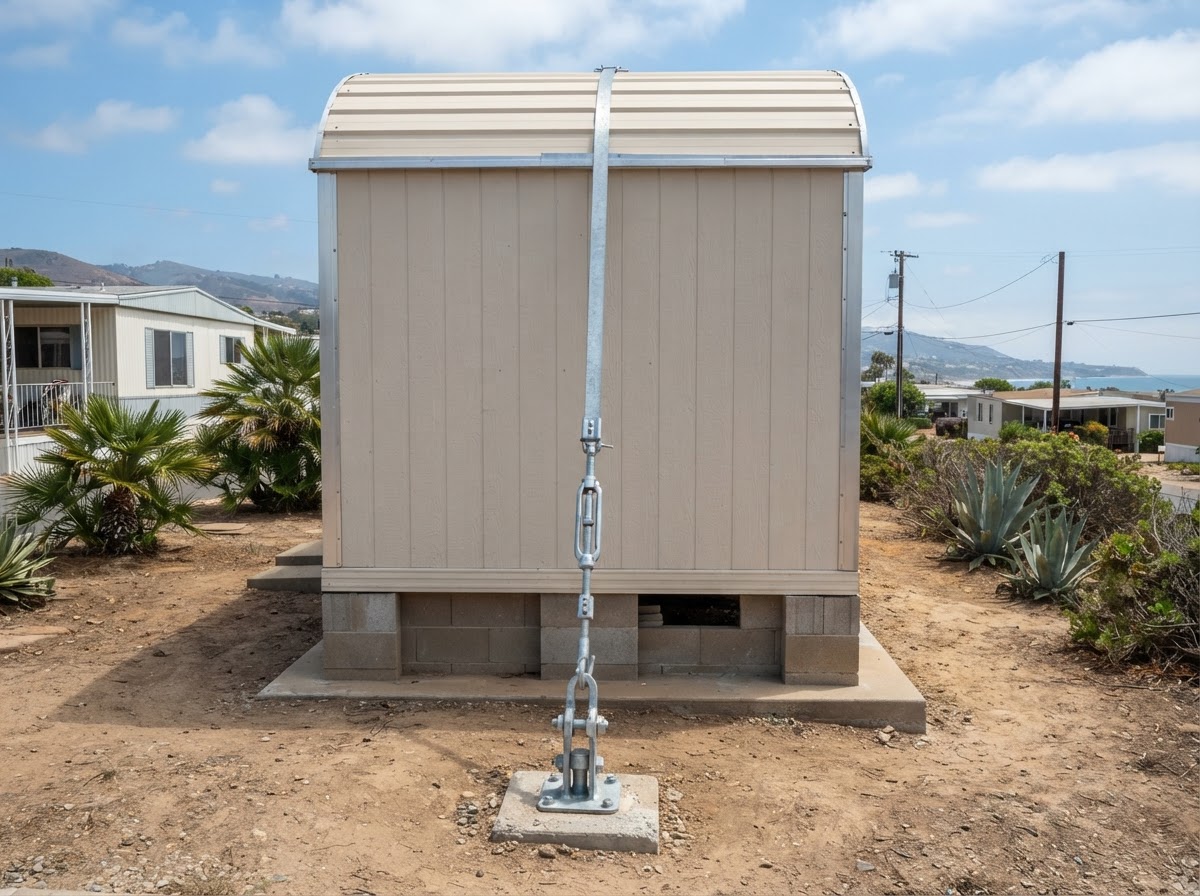
A manufactured home resting on supports can be pushed or lifted by wind, seismic forces, or other lateral loads. Tie-downs are the straps, cables, or other approved restraint components that connect the home to its anchors, transferring those loads into the anchoring system so the home stays secured to its supports.
A tie-down system is designed as part of the home's installation — the straps, the connection hardware, the anchoring points, and the attachment locations on the home all work together. How the system is arranged depends on the home's weight and configuration, the installation standard that applied, and the anchoring system it connects to. That's why a tie-down concern is evaluated against the specific installation, not against a one-size assumption.
Manufactured Home Tie-Down Components and Connections Near Huntington Beach
A tie-down system is an assembly of components, each of which affects whether the system performs as intended.
Straps or Restraint Components
Steel straps, cables, or other approved elements transfer load from the home to the anchor. Their material, condition, and routing all matter.
Connection Hardware
Buckles, tensioning hardware, bolts, and brackets connect the strap to the anchor and the home. Damaged or non-approved hardware compromises the assembly.
Anchoring Points
The anchors the straps connect to must be sound and appropriately set; a tie-down is only as reliable as the anchor it engages.
Attachment Locations
Where the system connects to the home — typically the chassis frame — must be capable of carrying the loads the strap transfers.
Compatible Installation Systems
Tie-downs are designed to work with a specific anchoring and support arrangement; mixing non-compatible components can affect performance.
No technical specifications — strap tension, spacing, or routing — are prescribed without applicable design information and a professional assessment. The appropriate components depend on the actual home, installation, and standards.
Signs of Mobile Home Tie-Down Deterioration in Huntington Beach
Visible conditions on straps or hardware can raise questions about the tie-down system. Because symptoms can have several causes, an evaluation considers the whole assembly.
Visible Corrosion
Rust on straps, buckles, or connection hardware can reduce a tie-down's capacity, particularly where components are exposed to moisture or salt air.
Damaged Components
Kinked, cut, frayed, or otherwise compromised straps or hardware may no longer perform as intended and deserve evaluation.
Loose or Displaced Connections
Straps that have slackened, slipped, or pulled away from their attachment points can indicate movement or hardware failure.
Missing Components
Straps, buckles, or anchors that are absent — whether removed, lost, or never installed — leave a gap in the restraint system.
Altered Systems
Tie-downs replaced with non-approved components, relocated, or modified without documentation may not meet the system's original design.
Weather-Related Deterioration
Long-term sun, moisture, and temperature exposure can weaken straps and hardware, even where damage isn't immediately obvious.
These signs are reasons to request an evaluation, not a diagnosis — and not a reason to attempt DIY repair or tensioning. Tie-down work involves loads that call for qualified assessment and approved components.
Tie-Down Corrosion and Maintenance Considerations in Coastal Orange County
Coastal moisture and salt exposure can affect metal tie-down components, but exposure varies property to property.
In a coastal setting, steel straps, buckles, and connection hardware can be exposed to salt air and moisture, which can contribute to corrosion over time and reduce a component's capacity. Whether a particular property's components are affected depends on proximity to the coast, shielding, drainage, and maintenance history.
Not every component is corroded, and corrosion isn't assumed without inspection. A property's actual exposure and component condition are determined by evaluation — and coastal factors are weighed alongside installation history and system design rather than treated as a default explanation.
Tie-Downs and Earthquake Bracing Serve Different Purposes
Tie-Downs
Tie-downs are restraint components that secure a home against wind and lateral forces. They're part of the installation's restraint system and depend on the anchors and hardware they connect to.
Earthquake Bracing
Earthquake bracing is an engineered system specifically designed for seismic forces, with its own standards and approval process. It may incorporate tie-downs, but ordinary tie-downs shouldn't be assumed to provide approved seismic bracing.
Because the systems serve different purposes, an evaluation considers whether a home has tie-downs, whether it has approved bracing, and whether either is performing as intended — without treating them as automatically equivalent.
Why Qualified Evaluation Matters for Tie-Down Systems
A tie-down system's performance depends on every component — the strap, the hardware, the anchor, the attachment point — and on the conditions it's in. Visible corrosion or damage tells you something deserves attention, but not whether the system still meets its design or what the appropriate response is. That calls for qualified evaluation.
An evaluation can assess a system with visible concerns, a system whose history isn't documented, or a system that may have been altered — and can help determine whether repair, replacement, or simply monitoring is appropriate.
Repair and Replacement Depend on the Installation
Where a tie-down concern is confirmed, the appropriate response depends on the installation, the approved components that apply, and the applicable requirements. Some situations call for replacing damaged straps or hardware; others involve addressing the anchoring system the straps connect to; still others may point toward a broader restraint or bracing assessment.
No universal replacement schedule is recommended. Tie-down service life depends on material, exposure, and maintenance history — which is why replacement decisions follow an evaluation rather than a fixed interval.
Verifying Applicable Installation and Permitting Standards
Applicable installation and permitting standards for tie-down work can vary by property classification, work type, and governing authority — which may be California HCD, a local jurisdiction, or another agency. Not every tie-down project has identical requirements.
Readers are directed toward verified official information rather than given universal specifications. The appropriate standards are determined for the actual property and work before definitive statements are made about what applies.
Related Restraint & Foundation Services
Mobile Home Tie-Down Questions from Huntington Beach Homeowners
Request a Mobile Home Tie-Down Estimate in Huntington Beach
If you've noticed corrosion, damage, or changes in your home's tie-down system, the first step is describing what you've seen. Share your property details and request information about appropriate next steps.