Mobile Home Earthquake Bracing and Seismic Support Systems in Huntington Beach, CA
In Southern California's seismic setting, the way a manufactured home is supported and restrained matters. Explore what earthquake-resistant bracing systems are, what they can and can't guarantee, and how to request bracing information in Huntington Beach and nearby Orange County communities.
Request a Mobile Home Earthquake Bracing Estimate
Share your property details and the mobile home earthquake bracing concern you'd like evaluated. Submitting opens your email client with your information pre-filled.
Request an Estimate
Tell us a little about your manufactured home and the issue you're experiencing. Submitting opens your email client with your details pre-filled — no information is stored on this website.
Understanding Mobile Home Earthquake Bracing in Huntington Beach
Earthquake-resistant bracing is a specific category of support and restraint — not a generic term for any tie-down or leveling work. Understanding what it is helps frame realistic expectations.
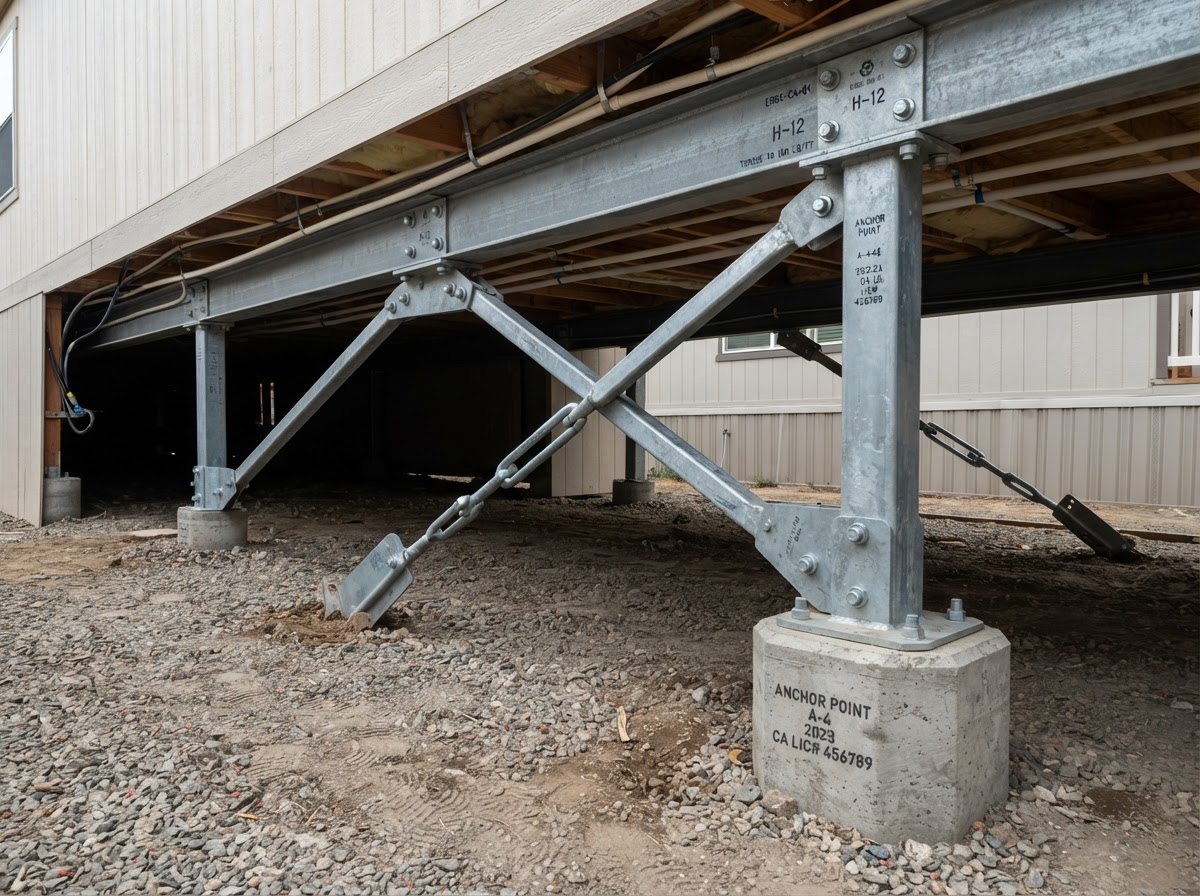
A manufactured home resting on supports can shift, bounce, or even leave its supports during strong seismic shaking. An earthquake-resistant bracing system is an engineered assembly designed to help the home resist those forces — connecting the chassis to approved supports or anchors in a way intended to reduce displacement and help the home stay on its supports during an event.
Bracing relates to the home's support and restraint system, but it's distinct from ordinary leveling or general tie-down terminology. Leveling addresses alignment; tie-downs address restraint against wind and lateral forces; bracing is specifically engineered for seismic forces. The three can overlap in components and concepts, but they're not interchangeable — and treating them as the same can lead to a system that wasn't designed for the forces it's being asked to resist.
Earthquake-Resistant Bracing Systems for California Manufactured Homes
California recognizes earthquake-resistant bracing systems as a specific category, with its own standards and approval process.
California HCD provides information about earthquake-resistant bracing systems, including applicable forms and processes for installation and alteration. An ERBS is designed and approved as a system — not assembled from generic components — and the appropriate system depends on the home's configuration, weight, existing supports, and the standards that apply to the property.
Distinguishing ERBS from ordinary leveling or general tie-down terminology matters because the three respond to different forces. A system that holds a home level isn't automatically a seismic bracing system, and a tie-down designed for wind restraint isn't automatically an approved earthquake bracing system. Which system applies is determined for the actual home and property.
Seismic Support Considerations for Manufactured Homes Near Huntington Beach
Southern California's seismic setting makes proper support and restraint relevant, but suitable measures depend on the property and structure.
Huntington Beach sits in a seismically active region, and that context makes how a manufactured home is installed, supported, and restrained a relevant topic. But hazard exposure and the measures that suit a given home depend on the property's location, the home's configuration and installation system, and applicable standards — not on a one-size assumption about every property.
A property's seismic hazard classification is determined from official hazard mapping and qualified evaluation, not from neighborhood generalizations. Bracing considerations are weighed against the actual home and site.
What a Bracing System Evaluation Considers
Home Configuration
Single-wide, double-wide, or multi-section homes have different restraint considerations.
Existing Support Systems
The current supports and their condition frame what bracing can build on.
Previous Installations
Any existing bracing or restraint system is evaluated for condition and appropriateness.
Applicable Approved Systems
The right system depends on approved options for the home and property.
Manufacturer Instructions
The home's own installation guidance is part of the conversation.
Permit Considerations
Which authority applies — HCD, local, or another — depends on the property and work.
Professional Assessment
Some situations call for licensed contractors or engineering input.
Site Conditions
Soil, drainage, and exposure at the lot influence what's appropriate.
No unverified installation method is recommended. The appropriate system is determined from the home, the site, and the applicable standards — not assumed.
What Earthquake Bracing Can and Cannot Guarantee for Huntington Beach Homes
Honest expectations matter. Bracing is designed to help reduce certain risks — not to eliminate them.
What It's Designed to Help With
An approved bracing system is engineered to help a manufactured home resist seismic forces and stay on its supports during shaking, which can reduce certain risks compared to an unbraced installation. Properly evaluated and installed systems are a meaningful consideration in a seismically active region.
What It Cannot Guarantee
No bracing system can guarantee the prevention of earthquake damage, injury, or displacement under all conditions. Seismic forces are variable and unpredictable, and no system eliminates risk. Any claim of complete protection — of an earthquake-proof home — would be inaccurate.
California HCD and Earthquake Bracing Permit Considerations
California HCD provides information about earthquake-resistant bracing systems, including applicable forms and processes.
California HCD's modifications and alterations resources include information about earthquake-resistant bracing systems and the forms that may apply to installation or alteration. Whether a permit is required, and which authority applies, depends on the property's classification, the work involved, and the governing jurisdiction — which may be HCD, a local authority, or another agency.
One permit process doesn't apply to every property. The appropriate authority and any required permits are determined for the actual home and work before definitive statements are made about what applies. Current requirements should be verified through official HCD resources before any regulatory claim is relied on.
How Earthquake Bracing and Anchoring Relate
Anchoring systems connect a manufactured home to its supports or the ground; earthquake bracing is an engineered system specifically designed for seismic forces. The two can share components and concepts, and a bracing system may incorporate anchoring — but ordinary anchors shouldn't be assumed to provide approved seismic bracing, and the two aren't automatically equivalent.
Understanding the relationship helps frame what an evaluation considers: whether a home has anchoring, whether it has approved bracing, and whether either is performing as intended. The appropriate scope depends on what's actually installed and what the applicable standards require.
Information Homeowners May Need When Investigating Bracing
Homeowners investigating bracing options often benefit from understanding their home's configuration and approximate age, what support and restraint system is currently in place, whether any bracing or anchoring has been added or altered, and what the applicable standards and approved systems are for their property.
Questions about permitting, engineering input, and which authority applies are part of the conversation. An evaluation can help frame those questions — and direct a homeowner toward the appropriate official resources — without assuming a particular system or permit path applies before the property has been considered.
Mobile Home Earthquake Bracing Questions from Huntington Beach Homeowners
Request Information About Mobile Home Earthquake Bracing in Huntington Beach
If you're considering earthquake bracing for your manufactured home, the first step is describing your home and what you'd like evaluated. Share your property details and request information about appropriate next steps.