Mobile Home Pier Repair and Foundation Support Services in Huntington Beach, CA
Uneven floors, visible deterioration beneath a home, or changes in how a manufactured home sits on its supports can raise questions about the piers carrying its weight. Explore what support piers do, the warning signs to watch for, and how to request a pier evaluation in Huntington Beach and nearby Orange County communities.
Request a Mobile Home Pier Repair and Support Systems Estimate
Share your property details and the mobile home pier repair and support systems concern you'd like evaluated. Submitting opens your email client with your information pre-filled.
Request an Estimate
Tell us a little about your manufactured home and the issue you're experiencing. Submitting opens your email client with your details pre-filled — no information is stored on this website.
Understanding Mobile Home Support Piers in Huntington Beach
Support piers are the link between a manufactured home's steel chassis and the ground beneath it. Understanding their role helps explain why pier concerns and broader foundation concerns aren't always the same thing.
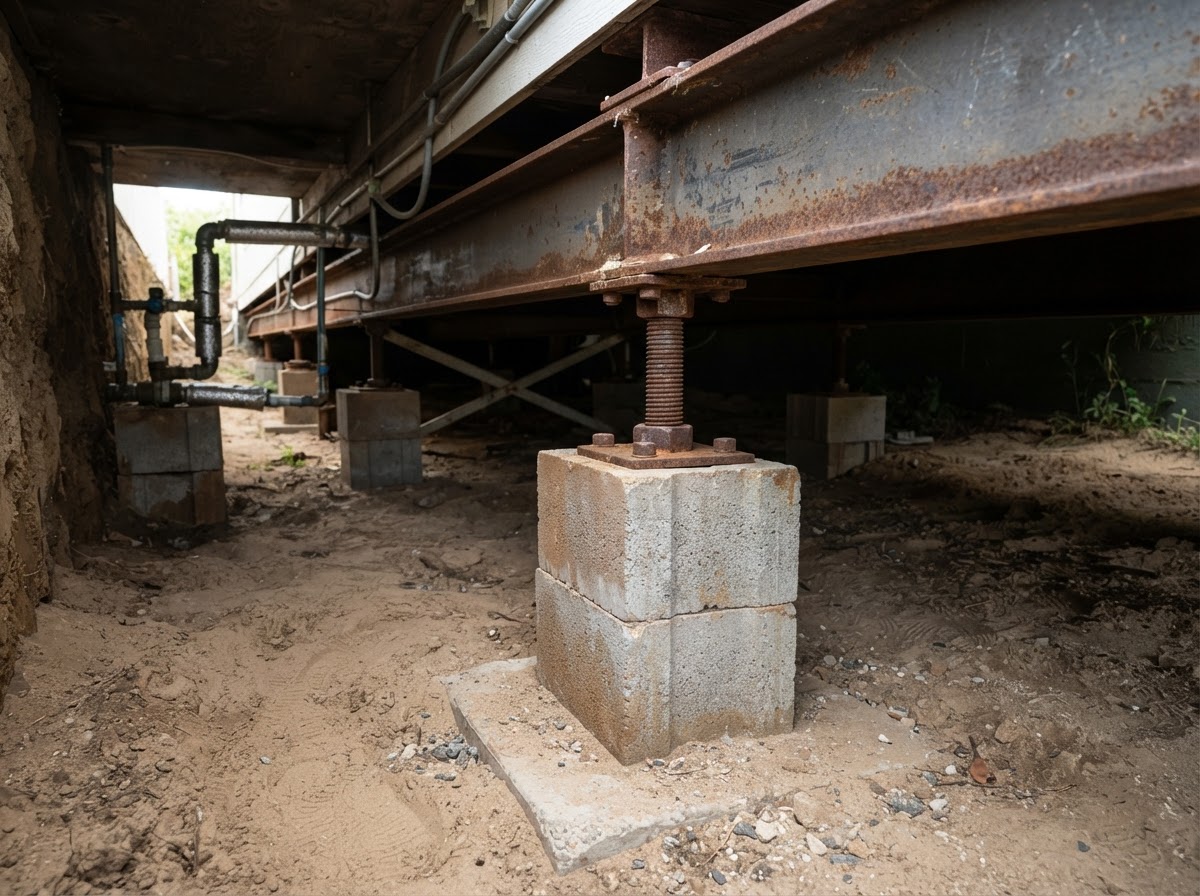
A manufactured home doesn't rest on a continuous poured perimeter foundation the way many site-built houses do. Instead, its steel chassis is carried by a series of support piers — adjustable steel jacks, concrete block assemblies, or other approved columns — that transfer the home's weight down to a bearing surface such as a concrete pad or footing. Because many of those piers are adjustable, the home's elevation can be set at installation and corrected later if it drifts.
How the piers are arranged — their material, spacing, and capacity — depends on the home's weight and configuration and on the installation standard that applied when it was placed. A single-wide, a double-wide, and a multi-section home distribute loads differently, and a home on an engineered permanent foundation may not use adjustable piers at all. That's why a pier concern is evaluated against the specific installation, not against a one-size assumption.
Signs of Mobile Home Pier Problems Near Huntington Beach
Changes in floors, visible conditions beneath the home, or the supports themselves can raise questions about the piers. Some symptoms point to a pier concern; others have different causes. A qualified assessment helps distinguish them.
Visible Deterioration
Rust, corrosion, cracking, or crumbling on a pier or its bearing surface can reduce its ability to carry load and deserves evaluation rather than assumption.
Displacement or Tilting
A pier that has shifted off its pad, tilted, or no longer sits plumb under the chassis beam may indicate movement in the support system or beneath it.
Changes in Alignment
A new slope, dip, or soft spot in the floor above a support area can reflect a change in how that pier is carrying its share of the load.
Support Movement
Piers that appear to have settled, heaved, or migrated from their original position are a reason to request a professional assessment.
Uneven Floors
A floor that reads differently from how it always has — especially near a single support point — can be a sign the pier beneath has shifted.
Moisture Exposure
Standing water, persistent dampness, or drainage that runs beneath the home can affect both the pier and the soil it bears on over time.
Corrosion of Hardware
Adjustable jack screws, caps, and connection hardware exposed to salt air or moisture may corrode, weakening the assembly even when the pier itself looks intact.
Changes in the Bearing Surface
Erosion, spalling, or cracking of the concrete pad or footing a pier rests on can undermine an otherwise sound support.
None of these signs by itself confirms a pier defect. They're reasons to request an evaluation — and not a reason to enter an unsafe crawlspace or attempt to adjust supports without qualified help.
Manufactured Home Pier and Support System Considerations in Orange County
Piers come in several approved forms, and the right configuration for a given home depends on its weight, layout, and the standard that governed its installation.
Adjustable Steel Jacks
Threaded steel jacks allow fine elevation adjustments and are common under many manufactured homes, but their capacity and condition depend on size, hardware, and exposure history.
Concrete Block Piers
Block assemblies carry load through stacked, mortared or dry-stacked units; their performance depends on alignment, bearing, and whether they've been affected by moisture or impact.
Bearing Pads
The pad or footing a pier rests on spreads load into the soil. A sound pier on a compromised pad can still settle, which is why the bearing surface is part of the evaluation.
Engineered Systems
Some installations use engineered pier-and-footing or permanent foundation systems designed for a specific home and site, with their own approved components and requirements.
No single material, spacing, or layout is appropriate for every home. A recommendation follows an evaluation of the actual installation and applicable standards — not a universal prescription.
Pier Repair Versus Broader Foundation Concerns
A concern involving a single support pier and a broader foundation problem can produce similar symptoms above, but the appropriate scope can be very different.
Pier repair typically addresses an individual support — replacing a corroded jack, resetting a displaced column, or restoring a bearing surface. It's the right scope when the issue is localized to one or a few piers and the rest of the support system is sound.
Foundation repair is broader. When movement is widespread, when the footings or soil beneath multiple piers are involved, or when the installation system itself no longer performs as intended, correcting a single pier won't resolve the underlying condition. Distinguishing the two is part of why an evaluation comes before any repair recommendation — applying a pier-level fix to a foundation-level problem tends to bring the symptoms back.
Coastal Exposure and Manufactured Home Support Piers in Huntington Beach
Huntington Beach's coastal setting can be relevant to pier condition, but exposure varies property to property and is never assumed from the neighborhood alone.
Salt-air exposure can contribute to corrosion of metal jack screws, caps, and connection hardware, and moisture or drainage changes beneath a home can affect both the piers and the bearing soil beneath their pads. Over time, those factors can shorten the service life of components that would otherwise perform well.
But not every Huntington Beach property faces the same exposure. Proximity to the coast, shielding by neighboring structures, lot drainage, skirting ventilation, and maintenance history all differ. A property's actual condition is determined by inspection — not by assuming coastal exposure has caused damage that hasn't been evaluated.
Why a Professional Pier Evaluation Matters
Because pier symptoms can share causes with footing, drainage, and broader foundation concerns, identifying the right scope depends on evaluating the actual installation. What's safely accessible, the home's configuration, the bearing conditions, and any history of past adjustments all shape what an appropriate recommendation looks like.
Some situations call for licensed contractors, qualified engineering input, or permitting, depending on the work and the property's governing authority. An evaluation helps frame those decisions before any repair is planned.
Information That Helps Frame a Pier Repair Estimate
Home Type
Single-wide, double-wide, multi-section, or modular — configuration affects how supports are arranged.
Approximate Age
The home's age can hint at the installation standard that applied and how long components have been in service.
Visible Symptoms
Where the slope, dip, or sticking door appears, and when it started, helps locate the relevant support area.
Previous Repairs
Any past leveling, pier replacement, or under-home work provides context for what's happening now.
Description of Concern
A short summary of what you've noticed — and any event that preceded it — frames the discussion.
Safely Observable Conditions
What you can see without entering an unsafe crawlspace — skirting gaps, standing water, tilted piers at the perimeter — can help.
Related Leveling & Foundation Services
Mobile Home Pier Repair Questions from Huntington Beach Homeowners
Request a Mobile Home Pier Repair Estimate in Huntington Beach
If you've noticed uneven floors, visible support deterioration, or changes beneath your home, the first step is describing what you've seen. Share your property details and request information about appropriate next steps.