
Mobile Home Leveling and Foundation Support Services in Huntington Beach, CA
Uneven floors, changes in door alignment, and concerns about a manufactured home's support system may warrant a closer look. Explore what mobile home leveling involves, the warning signs to watch for, and how to request a property estimate in Huntington Beach and nearby Orange County communities.
Request a Mobile Home Leveling Estimate
Share your property details and the mobile home leveling concern you'd like evaluated. Submitting opens your email client with your information pre-filled.
Request an Estimate
Tell us a little about your manufactured home and the issue you're experiencing. Submitting opens your email client with your details pre-filled — no information is stored on this website.
Understanding Mobile Home Leveling in Huntington Beach
Leveling refers to the process of bringing a manufactured home's floor and frame back toward an even, intended elevation relative to its supports. It's a structural alignment concern, not a cosmetic one — and it doesn't automatically resolve every underlying foundation problem.
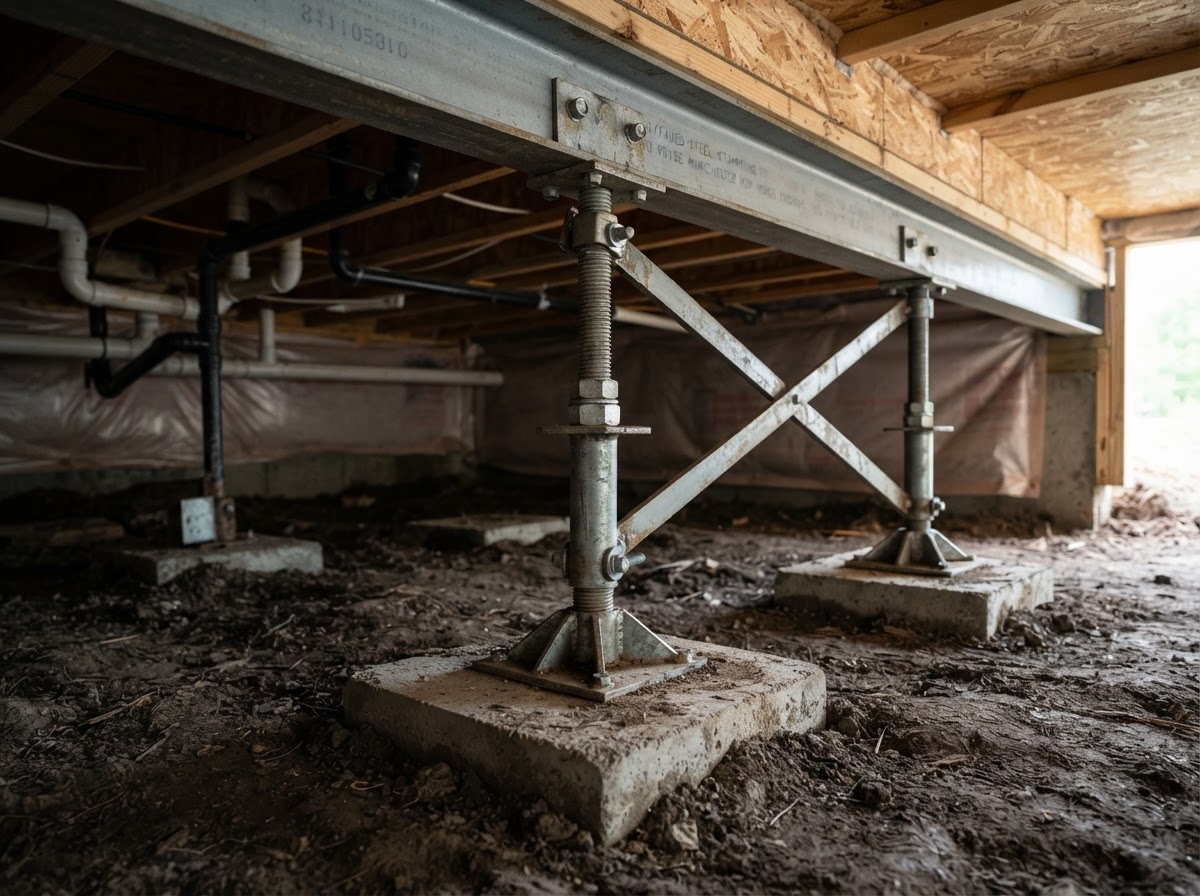
A manufactured home rests on a steel chassis carried by a network of adjustable piers, pads, and footings rather than a continuous poured perimeter foundation. Over time those supports can shift, settle, or deteriorate, and the home's elevation can drift away from where it was originally set. Leveling is the work of evaluating that drift and correcting the home's alignment against its supports.
It's important to understand what leveling is and isn't. Correcting alignment can address symptoms that follow from an uneven home — sloping floors, binding doors, gaps at interior joints. But leveling alone doesn't repair deteriorated piers, damaged footings, or an installation system that no longer performs as intended. Where the supports themselves are the problem, the appropriate scope may be broader than leveling alone, which is why an evaluation considers the condition of the support system, not just the readings on top of it.
Signs a Mobile Home in Huntington Beach May Need Leveling
Changes in floors, doors, windows, skirting, or the space beneath a home can raise questions about its supports. Some symptoms may relate to leveling; others have different causes. A qualified assessment helps distinguish between them.
Uneven or Sloping Floors
A noticeable change in floor level — a slope, dip, or soft spot — may signal support movement and warrants closer investigation before any correction is planned.
Changes in Floor Slope
A floor that developed a new slope, or one that feels different from how it has always read, can reflect a shift in the supports beneath the home.
Sticking Doors
Interior or exterior doors binding against their frames, or swinging open on their own, can reflect alignment changes with several possible causes.
Window Alignment Concerns
Window frames that bind, stick, or show new gaps may indicate frame alignment affected by movement, installation conditions, or other factors.
Interior Finish Separation
Cracking at drywall seams, separating trim, or gaps opening along interior joints can follow movement in the structure beneath the finish.
Visible Support Concerns
Tilted, settled, or deteriorating piers or jack stands deserve evaluation. Unusual movement or displacement under a home is a reason to request a professional assessment.
Changes After Ground Movement
New symptoms appearing after an earthquake, heavy rains, or flooding may justify a fresh inspection, even if the home previously seemed stable.
Skirting Gaps or Displacement
Skirting that pulls away, cracks, or no longer sits flush can sometimes accompany movement beneath the home — though it can also have independent causes.
None of these symptoms by itself establishes a leveling or foundation diagnosis. They're reasons to request an evaluation, not to assume a particular repair — and not a reason to enter an unsafe crawlspace or attempt structural adjustment without qualified help.
How Mobile Home Foundation Supports Affect Leveling Near Huntington Beach
Leveling and the support system beneath a home are connected. The condition, spacing, and bearing of the supports shape how levelness is maintained — and how it's evaluated.
Support Piers
Piers carry the chassis load to the ground. Their material, condition, and bearing surface all influence how the home holds its elevation over time.
Footings & Pads
Concrete pads or footings spread the load into the soil. Settling, cracking, or erosion beneath a pad can translate into movement above.
Load Distribution
How weight is carried across the chassis and transferred through the supports affects where movement, if any, tends to show up first.
Original Installation
The home's original installation system — pier-and-pad, a permanent foundation, or a retrofit — frames what an appropriate evaluation considers.
Home Configuration
A single-wide, double-wide, or multi-section home distributes loads differently, which is why configuration matters to how leveling is approached.
Site Conditions
Soil, drainage, and exposure at the specific lot all influence how the supports perform — and vary property to property across Huntington Beach.
Specific pier spacing, pad dimensions, or designs shouldn't be prescribed without applicable standards and a professional assessment of the actual installation. The right approach depends on what's found at the property.
Common Factors Behind Mobile Home Leveling Concerns in Orange County
Several conditions can contribute to a home drifting out of alignment. Because the possible causes overlap, an evaluation looks at the whole picture rather than assuming a single culprit.
Support pier settling or deterioration, changes in the soil or subgrade beneath the pads, drainage or moisture changes, the home's own configuration and load distribution, and the condition of the original installation can all play a role. In coastal Southern California, exposure and drainage are part of the conversation, but they're weighed against everything else rather than treated as the default explanation.
A home that has been adjusted previously may behave differently than one that hasn't, and a home near a slope, in a low-lying lot, or in a community with shared infrastructure may have considerations another property doesn't. None of this means a particular home has a problem — only that the relevant factors are property-specific and deserve to be evaluated as such.
What to Consider During a Mobile Home Leveling Evaluation in Huntington Beach
A responsible evaluation starts with understanding the concern and ends with a plan that fits the actual property. The outline below is general and educational — not a guaranteed protocol or a promise of specific steps or timelines.
- 1
Describe the Concern
Identify the symptoms, when they started, and where they appear in the home.
- 2
Review Property Details
Home type, age, location, installation arrangement, and visible concerns frame the discussion.
- 3
Evaluate Conditions
Alignment, supports, site conditions, anchoring, and other relevant elements may be considered.
- 4
Understand Options
Different conditions call for different approaches; the scope depends on the findings.
- 5
Plan Next Steps
Review findings, any necessary professional involvement, and permitting before work proceeds.
What Appropriate Leveling Can — and Can't — Address
When It May Help
Where symptoms follow from an uneven home, appropriate assessment and correction can help restore alignment, improve how doors and windows operate, and address the visible effects of movement. Documented evaluation also creates a record that frames any future permitting or professional involvement.
What It Doesn't Guarantee
Leveling doesn't guarantee a permanent result, and it doesn't repair underlying support or foundation defects. If the supports themselves are failing, alignment alone won't solve the problem. Outcomes depend on the actual conditions found — which is why an evaluation comes first.
Related Leveling & Support Services
Mobile Home Leveling Questions from Huntington Beach Homeowners
Request a Mobile Home Leveling Estimate in Huntington Beach
If you've noticed uneven floors, sticking doors, or changes in your home's supports, the first step is describing what you've seen. Share your property details and request information about appropriate next steps.